
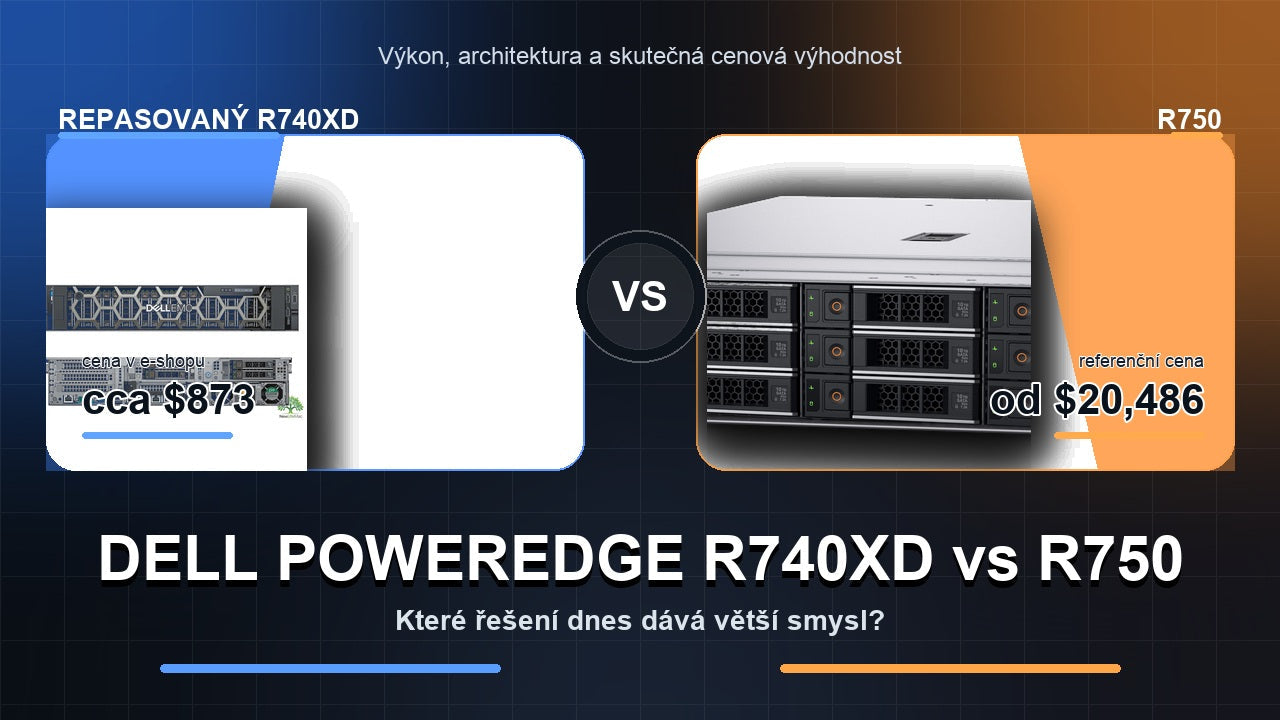
On paper, the answer seems simple. The Dell PowerEdge R750 is newer, more efficient, and architecturally more advanced. However, when I compare it to a specific Dell PowerEdge R740XD from our offering, priced at CZK 18,000, the entire comparison makes much more practical sense. It is precisely with the "R740XD – Xeon SILVER 4110 – 128 GB RAM" configuration that it becomes clear why a refurbished server is still worth it today.

I am using the still very relevant R750 as a comparison point. For April 2026, this is a more practical reference than pushing an older storage-capacity-focused server against the latest platform just for marketing.
The configuration you are actually buying
This consideration is not based on a general type of server, but on a specific unit from the offer. That is why it makes sense to stick to the real configuration "Xeon SILVER 4110 – 128 GB RAM" and not just compare the catalog maximum against the catalog maximum.
- Specific unit: Dell PowerEdge R740XD
- Price in our e-shop: CZK 18,000
- Processor: XEON SILVER 4110
- PassMark: 10274/1593
- Cores / Threads / Cache: 8/16/11
- Clock Speed: 3000
- TDP: 85
- RAM: 128 GB DDR4
Technical comparison side-by-side
The table combines a specific stock configuration of a refurbished unit with model options for both platforms. For ports, power supplies, drive bays, and PCIe slots, it always depends on the exact chassis and risers, so consider the values as a practical buying overview, not as the only possible configuration.
| Parameter | Dell PowerEdge R740XD | Dell PowerEdge R750 |
|---|---|---|
| Specific configuration in article | CPU: XEON SILVER 4110; RAM: 128 GB DDR4 | new Dell PowerEdge R750, manufacturer's standard configuration |
| Price | CZK 18,000 (approx. $873) | from $20,486 according to current reference offer |
| Form factor | 2U rack | 2U rack |
| Processor platform | Intel Xeon Scalable 1st and 2nd Gen | 3rd Gen Intel Xeon Scalable |
| Number of CPU sockets | 2 | 2 |
| Cores / threads of specific unit | 8/16/11 | up to 40 cores per CPU depending on configuration |
| Clock speed of specific unit | 3000 | depending on selected CPU |
| TDP / CPU power consumption | 85 W for installed CPU/CPU set | power per watt is better, but final consumption depends on configuration |
| Memory slots | 24 DIMM slots | 32 DIMM slots |
| Max RAM platform | up to 3 TB DDR4, more with PMem depending on CPU | up to 8 TB DDR4, more with PMem depending on configuration |
| RAM type and speed | DDR4 RDIMM / LRDIMM up to 2933 MT/s | DDR4 RDIMM / LRDIMM up to 3200 MT/s |
| Installed RAM in article | 128 GB DDR4 | depending on selected configuration |
| Drive bays | up to 24x 2.5" front plus rear bays depending on chassis | up to 24x 2.5" or 12x 3.5" depending on chassis |
| Installed storage in article | not specified in description | depending on selected configuration |
| Controllers / RAID | PERC / HBA / SATA / SAS / NVMe depending on configuration | PERC / HBA / SATA / SAS / NVMe depending on configuration |
| PCIe / expansion slots | up to 8 PCIe 3.0 slots depending on risers | PCIe Gen4, up to 8 slots depending on risers |
| Network ports | NDC / OCP depending on configuration | OCP 3.0, 1GbE to 25GbE+ depending on configuration |
| Remote management | iDRAC9 | iDRAC9 |
| Front ports | USB, VGA and status elements depending on front panel | USB, VGA and status elements depending on front panel |
| Rear ports | USB, VGA, serial port, iDRAC and LAN depending on configuration | USB, VGA, serial port, iDRAC and OCP/LOM depending on configuration |
| Internal boot / service ports | BOSS / internal USB / microSD depending on configuration | BOSS-S2 / internal USB / microSD depending on configuration |
| Power supplies | hot-plug redundant power supplies | hot-plug redundant power supplies |
| Power supply output | 750 W, 1,100 W, 1,600 W or higher depending on configuration | 800 W, 1,100 W, 1,400 W or higher depending on configuration |
| Note on power consumption | for xd variants, the number of disks and NVMe significantly determines consumption | power per watt is better, but final consumption depends on configuration |
Architecture and practical performance
To be fair, one thing needs to be said: the Dell PowerEdge R750 is based on a newer architecture. The older server uses the first-generation Intel Xeon Scalable platform, while the new model features the third-generation Intel Xeon Scalable platform, thus providing a greater technological reserve for future years.

The specific unit on offer scores approximately 10,274 PassMark points, so it is certainly not a server that would only be usable for "end-of-life" purposes. I am not saying that the newer model is not faster. It is. I am just reminding you that in normal operation for virtualization with an emphasis on storage capacity, archives, backups, and more data-intensive operations, the overall configuration often matters more than the generational label itself.
Price, RAM and disks in 2026
For me, the entire comparison boils down to money. CZK 18,000 for a ready-made Dell PowerEdge R740XD is a sum that still seems very attractive today. The price already includes 128 GB DDR4 RAM, which is something that can quickly inflate the budget of a new server. And since memory and disks remain expensive in April 2026, a refurbished setup can surprisingly be a strong business argument.
For the xd model, the economics of disks and capacity are absolutely crucial. This is where a refurbished solution is surprisingly strong. The Dell PowerEdge R740XD should therefore not be judged solely by its year of introduction, but by the work it is actually supposed to do and how much you are willing to pay for it.
Verdict for budget-sensitive demand
If I were choosing a server for a budget-controlled project today, I would unreservedly consider the Dell PowerEdge R740XD for virtualization with an emphasis on storage capacity, archives, backups, and more data-intensive operations. However, if you are building a platform for a longer horizon, dealing with power-per-watt, official support, and room for further growth, the Dell PowerEdge R750 makes more sense.
Product in our shop: R740XD – Xeon SILVER 4110 – 128 GB RAM
Manufacturer's reference model: Dell PowerEdge R750
Share:
Does the HP ProLiant DL380 G9 still make sense today? Comparison with the HPE ProLiant DL380 Gen10
Where does it make more sense to invest today: Dell PowerEdge R640 or Dell PowerEdge R650?